 WAFU
WAFU
Laparoscopic Trocar Airtightness Testing Solution
1. Why Must Laparoscopic Trocars Undergo Airtightness Testing?
The laparoscopic trocar is a critical passageway for inserting endoscopes or surgical instruments into the body cavity during minimally invasive surgery. It must have excellent sealing performance to ensure smooth surgical operations:
| Issue | Consequence |
|---|---|
| 🔸 Seal Failure | CO₂ gas leakage causing decreased insufflation pressure and limited surgical field visibility |
| 🔸 Leakage in Trocar Channel | Increased infection risk and higher postoperative complications |
| 🔸 Poor Airtightness | Failure to pass medical device regulatory certifications (e.g., EN ISO 80369, YY/T 0466) |
| 🔸 No Seal Testing Before Shipment for Disposable Trocars | Difficult traceability for large batch risks |
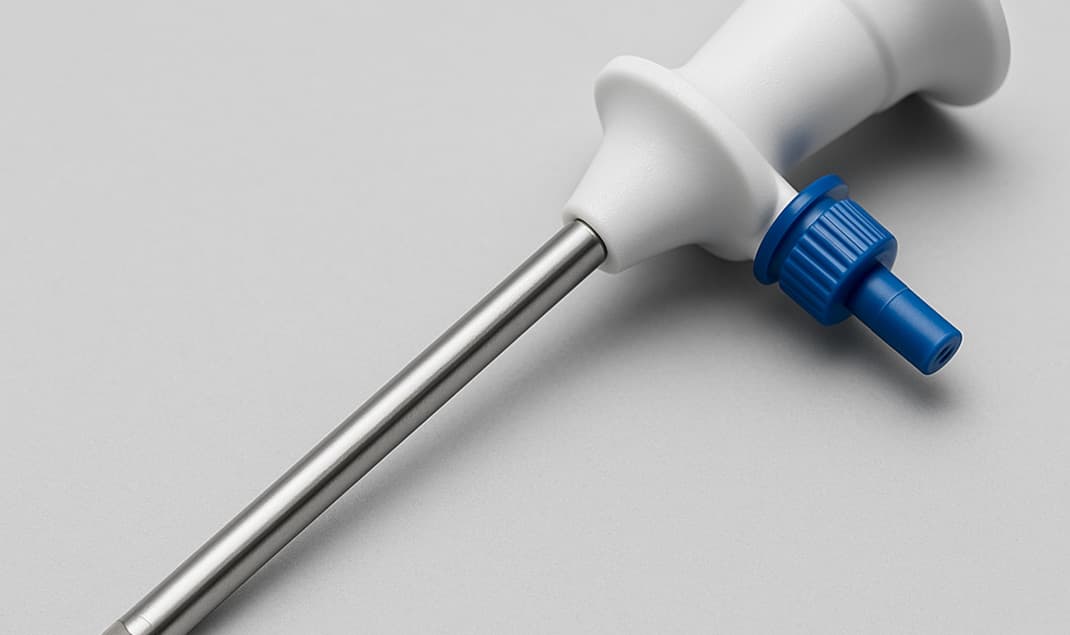 Figure 1: Laparoscopic Trocar
Case Study
In 2022, a medical device company in Zhejiang applied for EU CE certification for its disposable laparoscopic trocars. During third-party lab testing, the product failed due to valve seal leakage exceeding CO₂ simulation limits. Subsequently, the company adopted a micro-leakage level airtightness tester (mass flow method) with a leak limit set at ≤0.05 sccm, performing 100% inspection on every trocar. This ensured successful certification and improved product quality, enabling entry into the German and Italian markets.
Therefore, using high-precision airtightness testers to inspect key parts such as the trocar body, sealing valves, and catheter interfaces is a crucial step to ensure medical safety and regulatory compliance.
2. Common Airtightness/Seal Testing Methods
| Testing Method | Description |
|---|---|
| 🔹1. Mass Flow Method |
Real-time monitoring of micro-leaks in CO₂ channels or sealing interfaces High detection rate, suitable for medical micro-leakage requirements (sccm level) Non-destructive, suitable for both disposable and reusable trocars |
| 🔹2. Pressure Decay Method |
Detects pressure drop in cavities after pressurization High efficiency, suitable for simple structure or mass testing of trocars |
| 🔹3. Bubble Test (for R&D/Failure Analysis) |
Inject gas into the trocar and submerge it in water to observe bubbles Used only for development or sampling, not suitable for mass production |
3. Recommended Testing Areas and Process (Mass Flow Method Example)
| Testing Area | Description |
|---|---|
| ✅ Sealing Chamber of Trocar Valve | Can be tested individually or combined |
| ✅ Inner Channel of Sleeve (Simulating CO₂ Channel) | Can be tested individually or combined |
| ✅ Sealing Structure at Joint/Interface | Can be tested individually or combined |
| Step | Description |
|---|---|
| Clamping & Sealing | Insert the trocar into a custom airtight test fixture to seal the testing area |
| Pressurization & Inflation | Inject clean, dry gas (e.g., nitrogen, air) to a preset test pressure (20~50kPa) |
| Stabilization Test | Maintain constant pressure for a set time while measuring leak flow rate |
| Pass/Fail Judgment | Airtightness tester automatically determines if leakage exceeds the preset threshold |
| Sorting & Discharge | Automatically remove or divert NG (non-conforming) products and record test data for archiving |