 WAFU
WAFU
Complete Analysis of the Working Principle of Leak Tester
In the field of industrial manufacturing, the sealing performance of a product is directly related to its reliability and service life. From automotive components to medical devices, and from consumer electronics to many other industries, more and more sectors are paying attention to sealing quality inspection. So, how exactly does a leak tester work? This article will provide an in-depth explanation of the three mainstream testing principles and their technical characteristics.
1. Core Definition of a Leak Tester
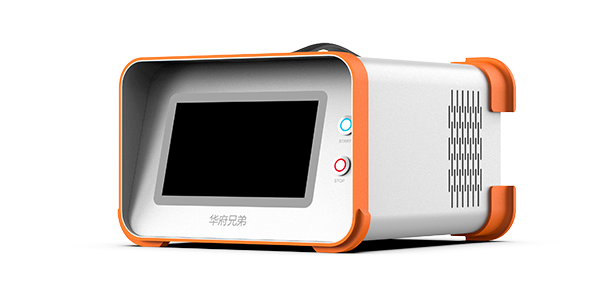
A leak tester is a precision instrument used to quantitatively or qualitatively determine whether a product or component has leakage and to accurately measure the leakage rate. According to different testing principles, mainstream leak testers can generally be divided into three major types.
2. Direct Pressure Method
The direct pressure method is a relatively basic and straightforward leak detection method. A certain pressure of clean gas (usually compressed air) is injected into the tested workpiece. After the pressure stabilizes, the air source is cut off, and a high-precision pressure sensor monitors the pressure drop inside the workpiece over a specified period.
If there is leakage in the tested cavity, a difference will appear between the two pressure readings. The magnitude of this difference reflects the leakage condition of the workpiece within the testing cycle. The larger the difference, the more serious the leakage. Using a standard leakage model, the actual leakage rate can be calculated.
Technical Features: Simple operation, low cost, and fast detection. Suitable for scenarios with medium to high leakage rates, such as plastic bottles and valves.

3. Differential Pressure Method
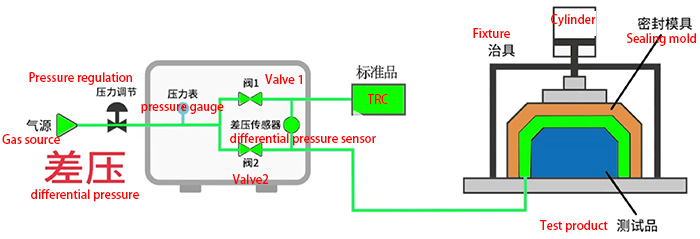
The differential pressure method is an upgraded version of the direct pressure method. Its core innovation lies in introducing a “reference part” as a comparison object. A standard reference piece (a product confirmed to be qualified) is connected to the reference port of the leak tester, and both the reference piece and the tested workpiece cavity are filled with gas simultaneously.
After a balancing period, the reference piece and the tested workpiece cavity are completely isolated, and the pressure is monitored for a period of time. A highly sensitive differential pressure sensor detects the pressure difference between them. If the pressure difference remains within the allowable range, the tested product is considered qualified; otherwise, it is judged as unqualified.
Technical Features: Significantly higher accuracy than the direct pressure method and effective in offsetting environmental influences such as temperature and pressure fluctuations. It is currently one of the mainstream solutions for high-precision leak testing.
4. Flow Method
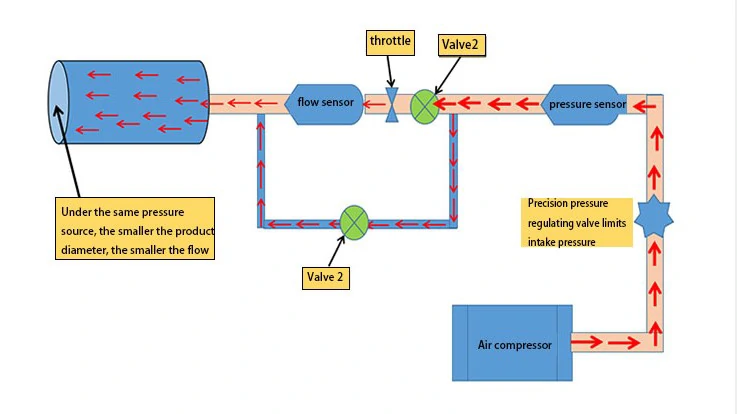
The working principle of the flow method is to continuously inject gas at a certain pressure into the tested workpiece. A mass flow meter detects changes in the gas flow entering the workpiece to determine whether the leakage level meets the required process standards.
If the tested part has leakage, gas fluctuations will appear in the air circuit. This represents the amount of gas leaking from the tested part per unit time, which is the leakage rate. A micro-flow sensor can accurately measure this small flow change.
Technical Features: Direct quantification of leakage rate, suitable for detecting extremely small leaks. High precision and fast response.
Testing methods are not limited to a single choice. When product requirements allow, multiple detection methods can be used simultaneously.
Regardless of the detection method, there are generally two gas filling approaches: positive pressure and negative pressure. Positive pressure means injecting gas into the tested workpiece, while negative pressure means vacuum extraction. Depending on product requirements, either method can be selected, or both positive and negative pressure testing can be performed.
5. Four Basic Stages of the Testing Cycle
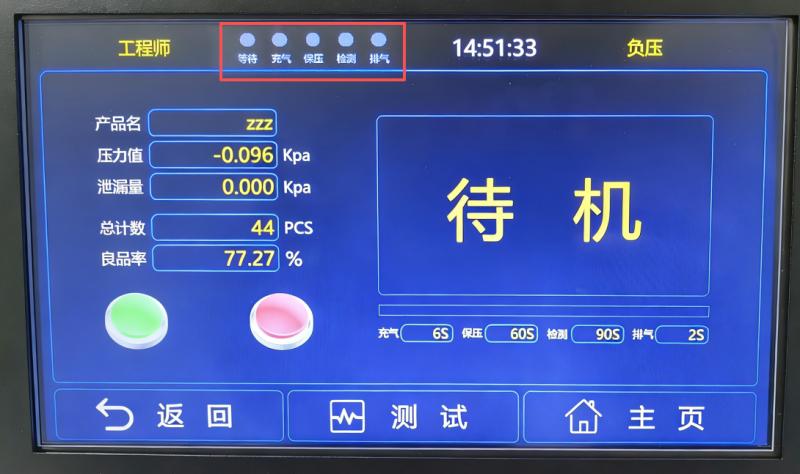
Regardless of which testing principle is used, the working process of a leak tester typically includes four basic stages:
(1) Pressurization Stage
Set the system test pressure to P and open the gas valve to inject gas at the same pressure into both the tested product and the reference product.
(2) Stabilization Stage
After the pressurization process is completed, the gas valve is closed to cut off the gas source. During this stage, due to gas impact and oscillation, the pressure and temperature of the injected gas may fluctuate. A certain delay is required until the pressure stabilizes before measuring pressure changes.
(3) Testing Stage
This stage involves sensor data collection and output. Within the preset time, the pressure difference is read and calculated, then compared with the preset inspection standards to determine whether leakage exists.
(4) Exhaust Stage
After the test is completed, all gas valves are opened to release the remaining gas in the container to the atmosphere through the exhaust valve, ending one complete testing cycle.
6. Conclusion
Leak testers have evolved from the traditional “water immersion method” to modern technologies such as direct pressure, differential pressure, and flow methods. Both testing accuracy and efficiency have continuously improved.
Understanding the working principles and applicable scenarios of different detection methods can help manufacturing companies select the most suitable leak testing solution based on their product characteristics and quality requirements, building a solid defense for product quality.